Schools
Stanford Geophysicists: Major Earthquakes Coming
Research by Stanford scientists focuses on geologic features and activity in the Himalayas and Pacific Northwest that could mean those areas are primed for major earthquakes.
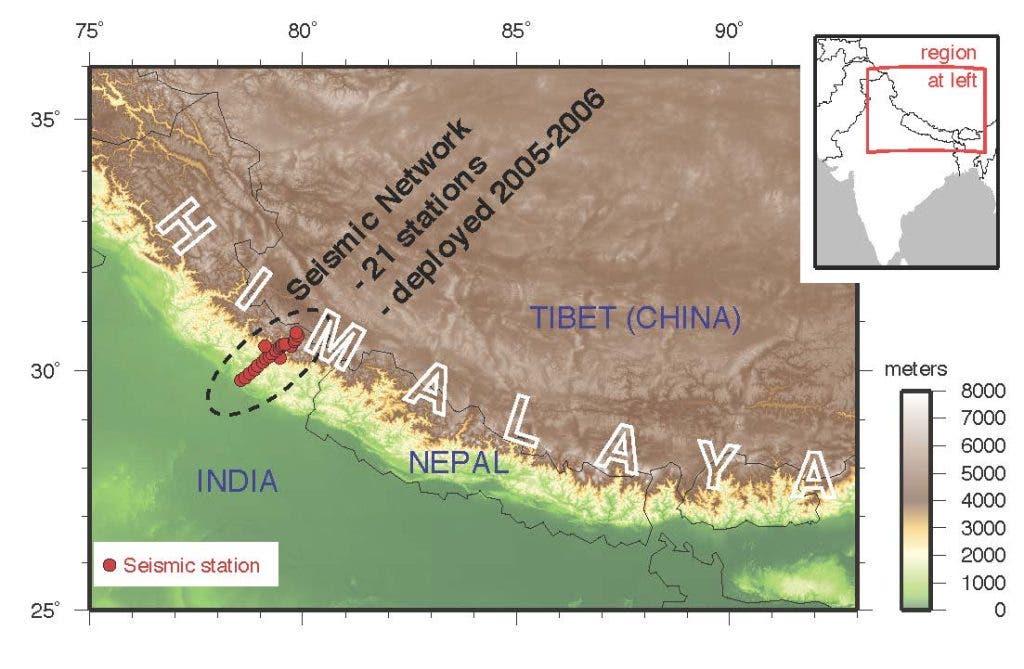
Stanford geophysicists were well represented at the meeting of the American Geophysical Union last week in San Francisco. Included among the many presentations were several studies that relate to predicting – and preparing for – major earthquakes in the Himalaya Mountains and the Pacific Northwest.
A big one in the Himalayas
The Himalayan range was formed, and remains currently active, due to the collision of the Indian and Asian continental plates. Scientists have known for some time that India is subducting under Asia, and have recently begun studying the complexity of this volatile collision zone in greater detail, particularly the fault that separates the two plates, the Main Himalayan Thrust (MHT).
Find out what's happening in San Carloswith free, real-time updates from Patch.
Previous observations had indicated a relatively uniform fault plane that dipped a few degrees to the north. To produce a clearer picture of the fault, Warren Caldwell, a geophysics doctoral student at Stanford, has analyzed seismic data from 20 seismometers deployed for two years across the Himalayas by colleagues at the National Geophysical Research Institute of India.
The data imaged a thrust dipping a gentle two to four degrees northward, as has been previously inferred, but also revealed a segment of the thrust that dips more steeply (15 degrees downward) for 20 kilometers. Such a ramp has been postulated to be a nucleation point for massive earthquakes in the Himalaya.
Find out what's happening in San Carloswith free, real-time updates from Patch.
Although Caldwell emphasized that his research focuses on imaging the fault, not on predicting earthquakes, he noted that the MHT has historically been responsible for a magnitude 8 to 9 earthquake every several hundred years.
"What we're observing doesn't bear on where we are in the earthquake cycle, but it has implications in predicting earthquake magnitude," Caldwell said. "From our imaging, the ramp location is a bit farther north than has been previously observed, which would create a larger rupture width and a larger magnitude earthquake."
Caldwell's adviser, geophysics Professor Simon Klemperer, added that recent detections of magma and water around the MHT indicate which segments of the thrust will rupture during an earthquake.
"We think that the big thrust vault will probably rupture southward to the Earth's surface, but we don't expect significant rupture north of there," Klemperer said. The findings are important for creating risk assessments and disaster plans for the heavily populated cities in the region.
Measuring small tremors in the Pacific Northwest
The Cascadia subduction zone, which stretches from northern California to Vancouver Island, has not experienced a major seismic event since it ruptured in 1700, an 8.7–9.2 magnitude earthquake that shook the region and created a tsunami that reached Japan. And while many geophysicists believe the fault is due for a similar scale event, the relative lack of any earthquake data in the Pacific Northwest makes it difficult to predict how ground motion from a future event would propagate in the Cascadia area, which runs through Seattle, Portland and Vancouver.
Stanford postdoctoral scholar Annemarie Baltay presented research on how measurements of small seismic tremors in the region can be utilized to determine how ground motion from larger events might behave. Baltay's research involves measuring low amplitude tectonic tremor that occurs 30 kilometers below Earth's surface, at the intersections of tectonic plates, roughly over the course of a month each year.
By analyzing how the tremor signal decays along and away from the Cascadia subduction zone, Baltay can calculate how ground motion activity from a larger earthquake will dissipate. An important application of the work will be to help inform new construction how best to mitigate damage should a large earthquake strike.
"We can't predict when an earthquake will occur, but we can try to be very prepared for them," Baltay said. "Looking at these episodic tremor events can help us constrain what the ground motion might be like in a certain place during an earthquake."
Though Baltay has focused on the Cascadia subduction zone, she said that the technique could be applied in areas of high earthquake risk around the world, such as Alaska and Japan.
Cascadia quake simulations
The slow slip and tremor events in Cascadia are also being studied by Stanford geophysics Professor Paul Segall, although in an entirely different manner. Segall's group uses computational models of the region to determine whether the cumulative effects of many small events can trigger a major earthquake.
"You have these small events every 15 months or so, and a magnitude 9 earthquake every 500 years. We need to known whether you want to raise an alert every time one of these small events happens," Segall said. "We're doing sophisticated numerical calculations to simulate these slow events and see whether they do relate to big earthquakes over time. What our calculations have shown is that ultimately these slow events do evolve into the ultimate fast event, and it does this on a pretty short time scale."
Unfortunately, so far Segall's group has not seen any obvious differences in the numerical simulations between the average slow slip event and those that directly precede a big earthquake. The work is still young, and Segall noted that the model needs refinement to better match actual observations and to possibly identify the signature of the event that triggers a large earthquake.
"We're not so confident in our model that public policy should be based on the output of our calculations, but we're working in that direction," Segall said.
One thing that makes Segall's work difficult is a lack of data from actual earthquakes in the Cascadia region. Earlier this year, however, earthquakes in Mexico and Costa Rica occurred in areas that experience slow slip events similar to those in Cascadia.
--Stanford News Service
Don’t be left out of the conversation taking place in San Carlos--Sign up for our daily newsletter | Like us on Facebook | Follow us on Twitter| Start a blog
Don’t be left out of the conversation taking place in Belmont--Sign up for our daily newsletter|Like Belmont|Patch on Facebook | Follow us on Twitter | Start your own blog

